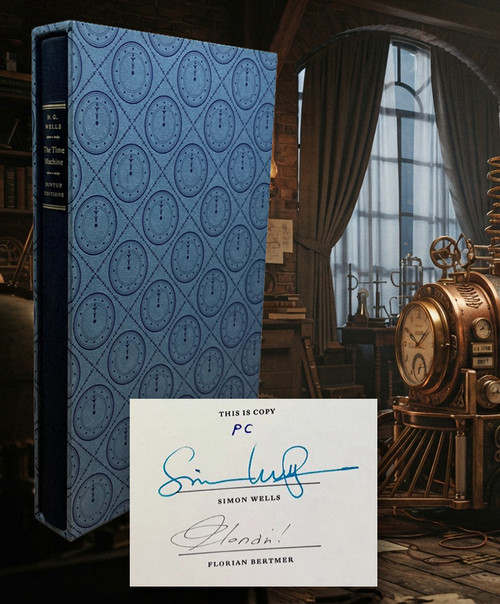



 Certified Authentic
Personally signed by Christopher Priest and Florian Bertmer.
SINGED NUMBERED EDITION OF 250. THIS IS A "PC" COPY.

Suntup Editions 2020. "The Invisible Man" by H.G. Wells. Signed Numbered Edition. Signed by Christopher Priest and Florian Bertmer. "PC" Edition. The Numbered edition is a quarter cloth binding with custom designed paper boards, which are printed letterpress. The spine is covered in a two-toned cloth and endsheets are Hahnemühle Ingress. The edition is housed in a paper covered slipcase and is limited to 250 copies.
The Invisible Man
The Invisible Man is a science fiction novel by H. G. Wells. Originally serialized in Pearson's Weekly in 1897, it was published as a novel the same year. The Invisible Man to whom the title refers is Griffin, a scientist who has devoted himself to research into optics and who invents a way to change a body's refractive index to that of air so that it neither absorbs nor reflects light. He carries out this procedure on himself and renders himself invisible, but fails in his attempt to reverse it. A practitioner of random and irresponsible violence, Griffin has become an iconic character in horror fiction.
While its predecessors, The Time Machine and The Island of Doctor Moreau, were written using first-person narrators, Wells adopts a third-person objective point of view in The Invisible Man. The novel is considered influential, and helped establish Wells as the "father of science fiction".
SIGNED NUMBERED EDITION ("PC" Edition)
- Signed by Christopher Priest and Florian Bertmer.
- 6” x 9” trim size.
- Rounded smyth-sewn binding.
- Quarter cloth binding with custom designed paper boards printed letterpress.
- Introduction by Christopher Priest.
- Six ink illustrations by Florian Bertmer printed letterpress along with the text.
- Hahnemühle Bugra endpapers.
- Printed letterpress on Mohawk Via paper.
- Two color printing on title page.
- Housed in a custom designed paper covered slipcase.
- Limited to 250 copies.
Bonus Material
Appendix A: The Four Endings of The Invisible Man – The four different versions of Chapter 28’s conclusive words originally intended to be the last paragraph of the book.
Appendix B: Invisibility in Ancient Greece and in Nineteenth-Century Fiction – Exclusive excerpts from a collection of invisibility narratives that inspired H.G. Wells’s novel.
Appendix C: Technological Context: Röntgen Rays and Radio Waves – A valuable collection of articles that served as scientific inspiration for H.G. Wells’s novel.
H.G. Wells
Herbert George Wells (21 September 1866 – 13 August 1946) was an English writer. Prolific in many genres, he wrote dozens of novels, short stories, and works of social commentary, history, satire, biography and autobiography. His work also included two books on recreational war games. Wells is now best remembered for his science fiction novels and is often called the "father of science fiction", along with Jules Verne and the publisher Hugo Gernsback.
During his own lifetime, however, he was most prominent as a forward-looking, even prophetic social critic who devoted his literary talents to the development of a progressive vision on a global scale. A futurist, he wrote a number of utopian works and foresaw the advent of aircraft, tanks, space travel, nuclear weapons, satellite television and something resembling the World Wide Web. His science fiction imagined time travel, alien invasion, invisibility, and biological engineering. Brian Aldiss referred to Wells as the "Shakespeare of science fiction".
Wells rendered his works convincing by instilling commonplace detail alongside a single extraordinary assumption – dubbed “Wells's law” – leading Joseph Conrad to hail him in 1898 as "O Realist of the Fantastic!". His most notable science fiction works include The Time Machine (1895), The Island of Doctor Moreau (1896), The Invisible Man (1897), The War of the Worlds (1898) and the military science fiction The War in the Air (1907). Wells was nominated for the Nobel Prize in Literature four times.
Wells's earliest specialised training was in biology, and his thinking on ethical matters took place in a specifically and fundamentally Darwinian context.[9] He was also from an early date an outspoken socialist, often (but not always, as at the beginning of the First World War) sympathising with pacifist views. His later works became increasingly political and didactic, and he wrote little science fiction, while he sometimes indicated on official documents that his profession was that of journalist. Novels such as Kipps and The History of Mr Polly, which describe lower-middle-class life, led to the suggestion that he was a worthy successor to Charles Dickens, but Wells described a range of social strata and even attempted, in Tono-Bungay (1909), a diagnosis of English society as a whole. Wells was a diabetic and co-founded the charity The Diabetic Association (known today as Diabetes UK) in 1934.

- Publisher:
- Suntup Editions
- Edition:
- Signed Limited Edition
- Author:
- H.G. Wells
- Title:
- The Invisible Man
- Certification:
- Publisher