
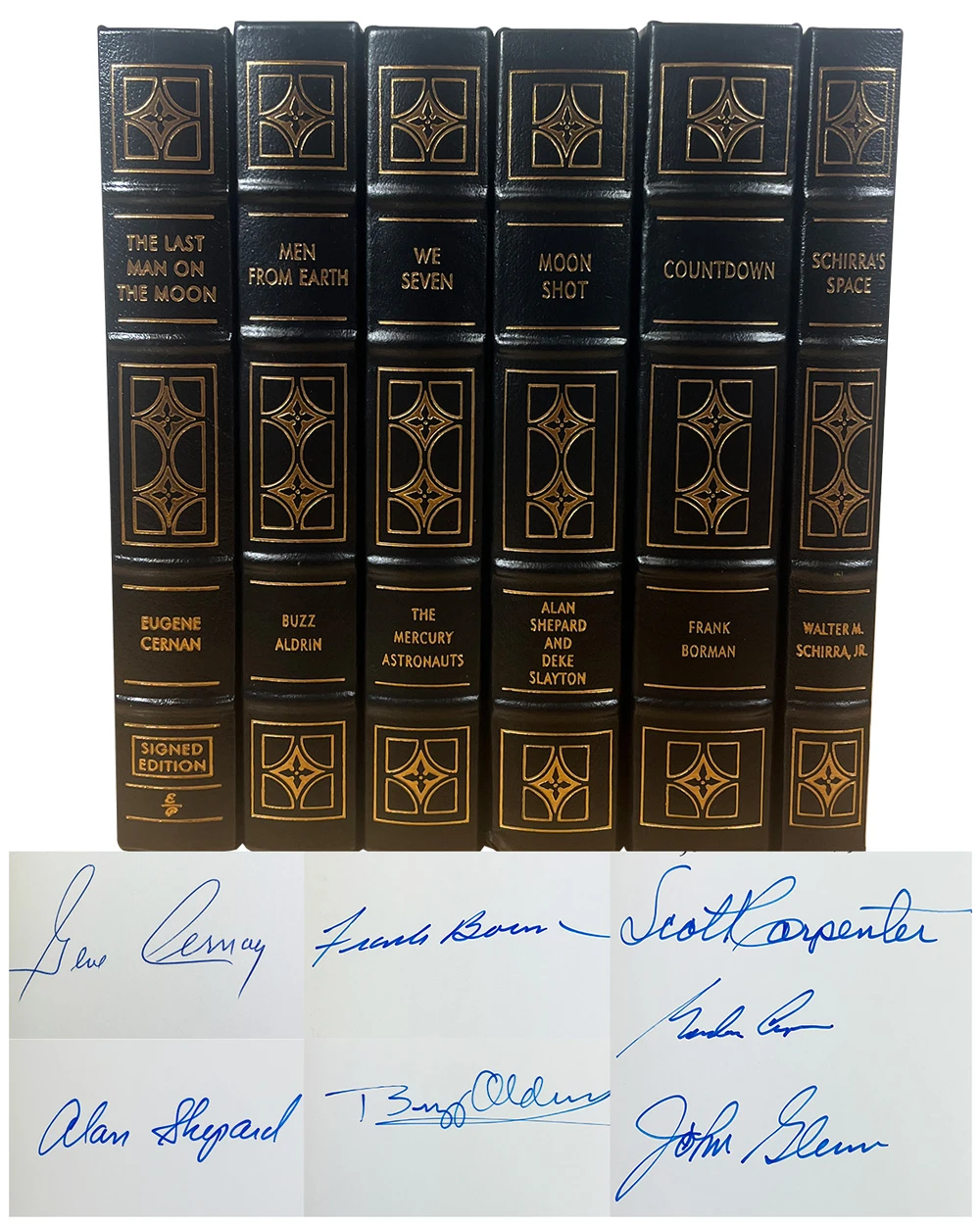




 Includes Certificate of Authenticity
The Astronaut Library, Signed by America’s Pioneers of Spaceflight. The Perfect Collection For The Space Historian.
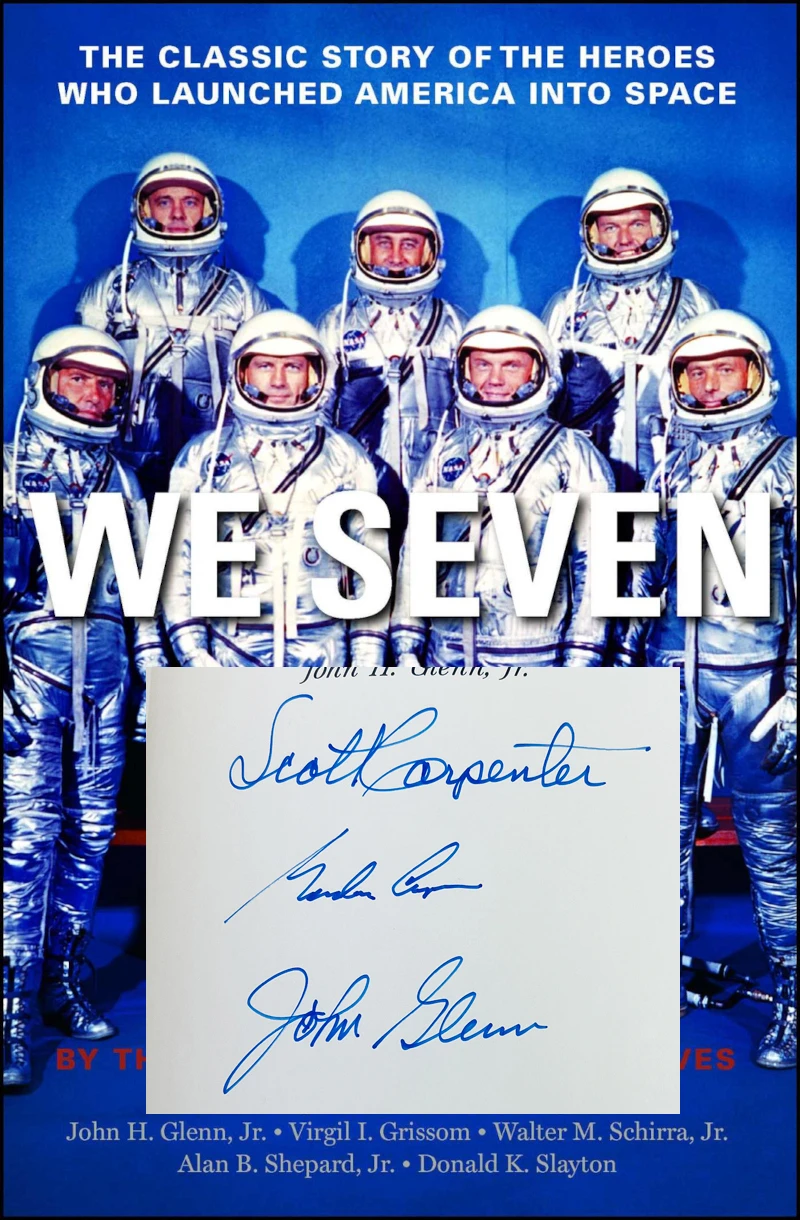
Featuring the autographs of Scott Carpenter, Gordon Cooper, John Glenn, Buzz Aldrin, Frank Borman, Alan Shepard, and Eugene Cernan.
“The first seven American astronauts were an admirable group of individuals chosen to sit at the apex of a pyramid of human effort… In volunteering to entrust their lives to Mercury’s spirit and Atlas; strength to blaze a trail for man into the empyrean, they chose to lead by following the opportunity that chance, circumstance, technology and history had prepared for them”
(Swenson, Grimwood & Alexander, 164-65).
Easton Press Norwalk CT. 1997. "The Astronaut Library" Signed Limited Edition partial matching numbers set. Full genuine black leather. From the library of the astronauts, this collection is now rare and out of print. Each volume contains a color frontispiece along with black-and-white photographs. "Schirra's Space" is a limited edition of only 25 Author's Copies.
Fine leather binding throughout with 22kt gold accents on the spine. A total of seven signatures along with the eight COAs. You will receive the original certificates of authenticity that were included with this collection, signed and dated by each astronaut along with a witness. These signed heirloom editions are luxuriously bound and can be treasured by your family for generations. This is the ultimate set for a spaceflight history library, and for the space collector.
Six Volume Set In One Shipment
1. "We Seven" personally signed by Scott Carpenter, Gordon Cooper, John Glenn. Number 75 of 3,000. Includes 3 COAs. [Very Fine]
2. "Men From Earth" personally signed by Buzz Aldrin. Includes COA. Number 75 of 3,000 [Very Fine].
3. "Countdown" personally signed by Frank Borman. Includes COA. Number 75 of 3,000 [Near Fine+ with very light marks]
4. "Schirra's Space". Includes COA. Private Issue. Limited Edition of 25 Author’s Copies. Not signed [Very Fine]
5. "Moon Shot" personally signed by Alan Shepard. Number 404 of 3,000. Includes COA. [Very Fine- with corner flaw]
6. "The Last Man On The Moon" personally signed by Eugene Cernan. Includes COA. [Very Fine]
Includes the 25‑Copy Limited Edition Specialty Variant of Schirra's Space.
Private Issue • Limited Edition of 25 Author’s Copies
A remarkably scarce specialty variant of Schirra’s Space, this volume comes from a private issue of just 25 author’s copies—a micro‑limitation far smaller than the standard Easton Press signed edition of 3,000. Produced outside the retail distribution line, this 25‑copy issue represents an ultra‑limited, non‑commercial production, likely created for internal use, author presentation, or archival purposes.
Bound in Easton Press’s signature premium full leather, with 22kt gilt decoration, raised hubs, archival paper, and Smyth‑sewn binding, this edition mirrors the craftsmanship of the Astronaut Library series while standing apart as a unique production. Unlike the standard edition, these author’s copies were not issued signed, underscoring their role as private, non‑retail variants.
The limitation page reads:
“This volume is from a private issue of 25 author’s copies.”
This statement confirms its status as a specialty production—one seldom seen on the market and prized by collectors who seek unusual, behind‑the‑scenes Easton Press variants.

About the Astronaut Library
Released in 1997, the Easton Press Astronaut Library is one of the most celebrated modern limited‑edition space sets ever produced. Each volume offers a firsthand account of America’s early space program, written by the astronauts who lived it. The series covers Mercury, Gemini, and Apollo missions, providing personal narratives, mission details, and historical context from the pioneers of American spaceflight.
The set is prized for its:
- Authenticity — Every volume signed by the astronauts themselves
- Historical importance — Firsthand accounts of America’s earliest space missions
- Premium craftsmanship — Easton Press deluxe leather bindings
- Scarcity — Limited to 3,000 copies, with partial matching numbers
About the Authors
This set features signatures from some of the most legendary figures in NASA history:
- Buzz Aldrin — Apollo 11 lunar module pilot, second man on the Moon
- Frank Borman — Commander of Apollo 8, the first mission to orbit the Moon
- James Lovell — Commander of Apollo 13
- Scott Carpenter, Gordon Cooper, John Glenn — Mercury astronauts
- Walter Schirra — Mercury, Gemini, and Apollo astronaut
- Alan Shepard — First American in space; Apollo 14 commander
- Deke Slayton — Original Mercury astronaut and NASA’s Director of Flight Crew Operations
Their signatures make this set a direct link to the earliest era of American space exploration.
Reviews & Collector Reception
Collectors and rare‑book dealers consistently praise the Astronaut Library for its:
- Exceptional production quality
- Historical significance
- Comprehensive coverage of NASA’s early missions
- High desirability among space‑flight collectors
Features
Each one of these exquisite editions includes the following classic Easton Press qualities:
* Premium Leather
* Silk Moire Endleaves
* Distinctive Cover Design
* Hubbed Spine, Accented in Real 22KT Gold
* Satin Ribbon Page Marker
* Gilded Page Edges
* Long-lasting, High Quality Acid-neutral Paper
* Smyth-sewn Pages for Strength and Durability
* Beautiful Illustrations
COUNTDOWN
The exciting account included here of Borman's NASA years (he took part in the Gemini 7 and Apollo 8 spaceflights, and also served as a troubleshooter and project manager) augments Tom Wolfe's The Right Stuff with details, dialogue and perceptions that will interest admirers of that bestseller. In 1970, Borman went to work for Eastern Airlines, a company "riddled with inept management and uncaring unions," to eventually take over as president and CEO. His most difficult task: cutting labor costs. The book describes Eastern's prolonged, bitter struggle to remain independent, a management/labor fight Borman lost in 1986 when Eastern became part of Texas Air. The most impressive section of this highly readable autobiography, coauthored with novelist Sterling ( The President's Plane Is Missing ), is the depiction of Borman's confrontations with intransigent labor leaders and the dynamics of their negotiations. Also memorable is the tribute to Susan Borman's poignant struggle to be "the Perfect Wife married to the Perfect Husband who was the Perfect Astronaut in a Perfect American Family raising Perfect Children." Borman is now an aviation consultant.
To coincide with the 20th anniversary this July of the first manned lunar landing, these books provide intimate accounts of how NASA accomplished the national goal of putting a man on the moon before the end of the decade. In his book, Aldrin, the second man on the moon, interweaves the story of U.S. and Soviet efforts to reach the moon with his first-hand experience flying both the Gemini and Apollo missions during the height of the space race. His recounting of his two space flights is compelling, especially the account of the nearly aborted Apollo 11 lunar landing. In contrast to Aldrin's astronaut's point of view, Murray and Cox's book tells the Apollo story through the eyes of the NASA managers who guided the men and machines from the early days of the Space Task Group to the Apollo lunar missions. The result is the best account to date of how the enormous program was successfully accomplished. Full of insiders' anecdotes, this book truly humanizes the lunar landing story that too often has been told only in technological and bureaucratic terms. Relying heavily on interviews with the people behind the scenes, the authors vividly capture the spirit of Apollo, its triumphs and tragedies, and its ultimate success. When considering the likely demand for Apollo histories surrounding the anniversary, Aldrin's account may be considered complementary to his Apollo 11 crew mate Michael Collins's recent space history, Liftoff ( LJ 8/88)
Irreverent, provocative, and filled with fascinating anecdotes, this autobiography by one of America's first astronauts offers a revealing inside look at the early days of space flight and the men who captured the heart of the nation. Wally Schirra was the only one of the original seven NASA astronauts to command a spacecraft in all three pioneering space program-Mercury, Gemini, and Apollo. Born to a World War I-ace father and a barnstorming, wing-walking mother, he inherited a love of flying and spirit of adventure that served him well. In this chronicle of an important era in aviation history, Schirra takes us into space on his 1962 Mercury flight that orbited Earth six times and aboard Gemini for the first rendezvous of two manned craft in space. Never reluctant to discuss the problems along with the stunning successes of those exciting, formative years, Schirra openly describes the pressures, tensions, and dangers associated with launch.
Published as Project Mercury was thrilling the Free World at the height of the cold war, WE SEVEN was written by the original seven astronauts (and edited by LIFE magazine's John Dille). For researchers and space enthusiasts, the chapters offer valuable contemporaneous, first-person accounts of Project Mercury--from the men, to the machines, to the systems.
Particularly valuable are the accounts of the historic 1959 selection process (and selection medicine) at Lovelace Clinic and Wright-Patterson A.F.B. There are painstakingly technical accounts of the engineering and design work on the hardware in addition to first-person accounts of spaceflight itself, from the days when astronauts flew alone and then only briefly--for a lifetime of fame.
First military tests pilots and then engineers, the Mercury astronauts were not professional writers. The editor does a brilliant job of preserving the distinctive voices of the individual astronauts, while showcasing the highly technical subjects the men describe in WE SEVEN, a bestseller when it was first published in 1962.
A must for any spaceflight history library.
MOON SHOT
Shepard and the late Slayton, two of the original Mercury astronauts, here team up with two veteran space reporters to produce a firsthand account of the space program's early days. The narrative is at its best when it focuses on the astronauts' flight experiences-Shepard's brief Mercury flight, his lunar landing mission ten years later, and Slayton's long-delayed trip into space aboard the last Apollo mission in 1975. On the down side, its use of re-created conversations that pass as exposition weaken the narrative, making it sound more like a screenplay prospectus than a space history. For example, it is doubtful that John Glenn had to explain to his fellow astronauts what the Saturn launch vehicle was. One comes away wishing for more insight into what it was like to walk on the moon and less about the astronauts' pranks and peccadillos. Still, with the book's publication timed to coincide with this July's 25th anniversary of the first manned lunar landing, this title may see some demand.
From Publishers Weekly
Astronaut Lovell and Kluger, a contributing editor at Discover magazine, take us on the terrifying voyage of unlucky Apollo 13. Launched in April 1970 and manned by Lovell, Jack Swigert and Jack Haise, Apollo 13 was scheduled to orbit the moon while Lovell and Haise descended to its surface. En route, though, a cryogenic tank exploded, causing a loss of oxygen and power in the command module. Luckily, the LEM, the lunar module that was to land on the moon, was uninjured and the astronauts could survive briefly on its oxygen. What unfolds is a story of courage as the astronauts and the personnel at Mission Control in Houston labored to return the spacecraft to Earth. First, there was the crucial alignment to ascertain the position of the spacecraft. Then came the all-important "burn" to swing the spacecraft around the moon on a "free return" trajectory back to earth. And finally there was the important PC+2 burn to guide the ship to the South Pacific, making sure it would enter Earth's atmosphere precisely-if done wrong the craft would either incinerate or skip into orbit around the sun. Everything went perfectly and Apollo 13 splashed down in the Pacific. This is a gripping and frightening book that commands rapt attention. Photos not seen by PW. Author tour.
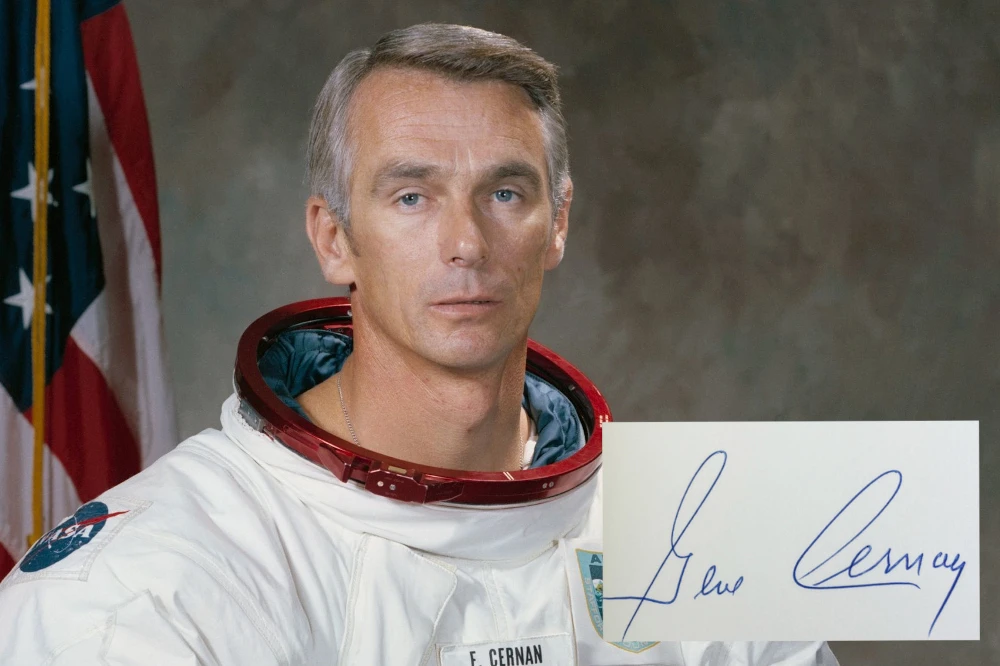
THE LAST MAN ON THE MOON
Eugene Cernan was a unique American who came of age as an astronaut during the most exciting and dangerous decade of space flight. His career spanned the entire Gemini and Apollo programs, from being the first person to spacewalk all the way around our world to the moment when he left man's last footprint on the moon as commander of Apollo 17.
Between those two historic events lay more adventures than an ordinary person could imagine as Cernan repeatedly put his life, his family, and everything he held dear on the altar of an obsessive desire. Written with New York Times–bestselling author Don Davis, The Last Man on the Moon is the astronaut story never before told—about the fear, love, and sacrifice demanded of the few who dare to reach beyond the heavens.
"Thrilling highlights . . . a book not just about space flight but also about the often-brutal competition that went on between the US and the Soviet Union." —Washington Times
MEN FROM EARTH
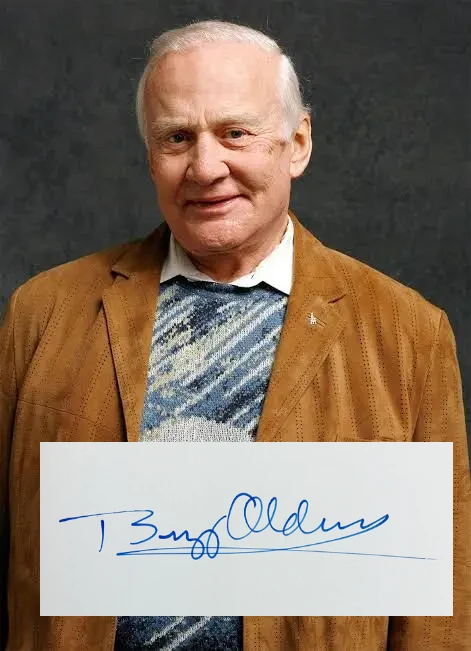
On July 20, 1969, Apollo 11 astronauts Buzz Aldrin and Neil Armstrong landed their Lunar Module on the moon's Sea of Tranquility and became the first two humans to walk on the moon. This unprecedented heroic endeavor was witnessed by the largest worldwide television audience in history. Marking the 20th Anniversary of the Apollo 11 lunar landing, Buzz publishes Men From Earth, a detailed and astonishing account of America's race with the Soviets to the moon. The book ends with an epilogue venturing Outward, which looks toward future space travel through the year 2009.
To coincide with the 20th anniversary this July of the first manned lunar landing, these books provide intimate accounts of how NASA accomplished the national goal of putting a man on the moon before the end of the decade. In his book, Aldrin, the second man on the moon, interweaves the story of U.S. and Soviet efforts to reach the moon with his first-hand experience flying both the Gemini and Apollo missions during the height of the space race. His recounting of his two space flights is compelling, especially the account of the nearly aborted Apollo 11 lunar landing. In contrast to Aldrin's astronaut's point of view, Murray and Cox's book tells the Apollo story through the eyes of the NASA managers who guided the men and machines from the early days of the Space Task Group to the Apollo lunar missions. The result is the best account to date of how the enormous program was successfully accomplished. Full of insiders' anecdotes, this book truly humanizes the lunar landing story that too often has been told only in technological and bureaucratic terms. Relying heavily on interviews with the people behind the scenes, the authors vividly capture the spirit of Apollo, its triumphs and tragedies, and its ultimate success. When considering the likely demand for Apollo histories surrounding the anniversary, Aldrin's account may be considered complementary to his Apollo 11 crew-mate Michael Collins's recent space history, Liftoff ( LJ 8/88). A review of Douglas MacKinnon and Joseph Baldanza's Footprints: The 12 Men Who Walked on the Moon Reflect on Their Flights, Their Lives and the Future , to be published by Acropolis in July, is scheduled to appear in our next issue.-- Ed. But for libraries considering only one title, Murray and Cox's book should be considered the essential purchase. - Thomas J. Frieling, Bainbridge Coll., Cal.
Copyright 1989 Reed Business Information, Inc.
WE SEVEN: By the Astronauts Themselves
The pioneer astronauts who took America into space tell their personal stories about the challenges they faced -- their fears, joys, friendships, and successes.
Chosen from hundreds of crackerjack pilots for their fitness, intelligence, and courage, the original Mercury Seven astronauts risked their lives to cross the space frontier. In We Seven, they take readers behind the scenes to show them their training, technology, and teamwork, and to share personal stories, including the lighter moments of their mission. They bring readers inside the Mercury program -- even into the space capsules themselves. We Seven straps you in with the astronauts and rockets you along for the ride.
Share Alan Shepard's exhilaration as he breaks through the earth's atmosphere. Endure moments of panic with Gus Grissom when his hatch blows, stranding him in the open sea. Race with John Glenn as he makes split-second life-or-death maneuvers during reentry, and feel his relief when he emerges safe but drenched with sweat.
Despite such heroism, Project Mercury was more than the story of individual missions. It defined the manned space flight program to come, from Gemini through Apollo. In We Seven, America's original astronauts tell us firsthand -- as only they can -- about the space program they pioneered, and share with us the hopes and dreams of the U.S. at the dawn of a new era.
SCHIRRA'S SPACE
- Publisher:
- Easton Press
- Edition:
- Signed Limited Edition
- Binding:
- Full Genuine Leather
- Certification:
- COA
- Title:
- We Seven
- Title:
- Men From Earth
- Title:
- Countdown
- Title:
- Schirra's Space
- Title:
- Moon Shot
- Title:
- The Last Man On The Moon
![Easton Press,"Schirra's Space" Captain Walter M. Schirra, Jr. Signed Limited Edition w/COA [Sealed]](https://cdn11.bigcommerce.com/s-eohzfjch7f/images/stencil/500x659/products/400/1989/400-177-2__68662.1601670342.jpg?c=1 "Easton Press,\"Schirra's Space\" Captain Walter M. Schirra, Jr. Signed Limited Edition w/COA [Sealed]")


![Easton Press "Ragtime" E.L. Doctorow, Signed Limited Edition [Sealed]](https://cdn11.bigcommerce.com/s-eohzfjch7f/images/stencil/500x659/products/1865/6489/eps940-2__14858.1601671617.jpg?c=1 "Easton Press \"Ragtime\" E.L. Doctorow, Signed Limited Edition [Sealed]")

