
![Gale E. Christianson "In the Presence of the Creator: Isaac Newton and His Times" Leather Bound Collector's Limited Edition [Sealed]](https://cdn11.bigcommerce.com/s-eohzfjch7f/images/stencil/500x659/products/1505/28955/1000x1250_Creater__42967.1766162325.jpg?c=1 "Gale E. Christianson \"In the Presence of the Creator: Isaac Newton and His Times\" Leather Bound Collector's Limited Edition [Sealed]")
![Gale E. Christianson "In the Presence of the Creator: Isaac Newton and His Times" Leather Bound Collector's Limited Edition [Sealed]](https://cdn11.bigcommerce.com/s-eohzfjch7f/images/stencil/1280x1280/products/1505/28955/1000x1250_Creater__42967.1766162325.jpg?c=1 "Gale E. Christianson \"In the Presence of the Creator: Isaac Newton and His Times\" Leather Bound Collector's Limited Edition [Sealed]")
![Gale E. Christianson "In the Presence of the Creator: Isaac Newton and His Times" Leather Bound Collector's Limited Edition [Sealed]](https://cdn11.bigcommerce.com/s-eohzfjch7f/images/stencil/50x50/products/1505/28955/1000x1250_Creater__42967.1766162325.jpg?c=1 "Gale E. Christianson \"In the Presence of the Creator: Isaac Newton and His Times\" Leather Bound Collector's Limited Edition [Sealed]")
![Gale E. Christianson "In the Presence of the Creator: Isaac Newton and His Times" Leather Bound Collector's Limited Edition [Sealed]](https://cdn11.bigcommerce.com/s-eohzfjch7f/images/stencil/50x50/products/1505/28838/IMG_0098_edited__94652.1766162324.jpg?c=1 "Gale E. Christianson \"In the Presence of the Creator: Isaac Newton and His Times\" Leather Bound Collector's Limited Edition [Sealed]")
![Gale E. Christianson "In the Presence of the Creator: Isaac Newton and His Times" Leather Bound Collector's Limited Edition [Sealed]](https://cdn11.bigcommerce.com/s-eohzfjch7f/images/stencil/50x50/products/1505/28839/IMG_0099_edited__09916.1766162324.jpg?c=1 "Gale E. Christianson \"In the Presence of the Creator: Isaac Newton and His Times\" Leather Bound Collector's Limited Edition [Sealed]")
![Gale E. Christianson "In the Presence of the Creator: Isaac Newton and His Times" Leather Bound Collector's Limited Edition [Sealed]](https://cdn11.bigcommerce.com/s-eohzfjch7f/images/stencil/50x50/products/1505/28837/IMG_0100_edited__74392.1766162324.jpg?c=1 "Gale E. Christianson \"In the Presence of the Creator: Isaac Newton and His Times\" Leather Bound Collector's Limited Edition [Sealed]")
![Gale E. Christianson "In the Presence of the Creator: Isaac Newton and His Times" Leather Bound Collector's Limited Edition [Sealed]](https://cdn11.bigcommerce.com/s-eohzfjch7f/images/stencil/50x50/products/1505/28835/IMG_0102_edited__59975.1766162324.jpg?c=1 "Gale E. Christianson \"In the Presence of the Creator: Isaac Newton and His Times\" Leather Bound Collector's Limited Edition [Sealed]")
![Gale E. Christianson "In the Presence of the Creator: Isaac Newton and His Times" Leather Bound Collector's Limited Edition [Sealed]](https://cdn11.bigcommerce.com/s-eohzfjch7f/images/stencil/50x50/products/1505/28833/IMG_0103_edited__75127.1766162324.jpg?c=1 "Gale E. Christianson \"In the Presence of the Creator: Isaac Newton and His Times\" Leather Bound Collector's Limited Edition [Sealed]")
![Gale E. Christianson "In the Presence of the Creator: Isaac Newton and His Times" Leather Bound Collector's Limited Edition [Sealed]](https://cdn11.bigcommerce.com/s-eohzfjch7f/images/stencil/1280x1280/products/1505/28955/1000x1250_Creater__42967.1766162325.jpg "Gale E. Christianson \"In the Presence of the Creator: Isaac Newton and His Times\" Leather Bound Collector's Limited Edition [Sealed]")
![Gale E. Christianson "In the Presence of the Creator: Isaac Newton and His Times" Leather Bound Collector's Limited Edition [Sealed]](https://cdn11.bigcommerce.com/s-eohzfjch7f/images/stencil/1280x1280/products/1505/28838/IMG_0098_edited__94652.1766162324.jpg "Gale E. Christianson \"In the Presence of the Creator: Isaac Newton and His Times\" Leather Bound Collector's Limited Edition [Sealed]")
![Gale E. Christianson "In the Presence of the Creator: Isaac Newton and His Times" Leather Bound Collector's Limited Edition [Sealed]](https://cdn11.bigcommerce.com/s-eohzfjch7f/images/stencil/1280x1280/products/1505/28839/IMG_0099_edited__09916.1766162324.jpg "Gale E. Christianson \"In the Presence of the Creator: Isaac Newton and His Times\" Leather Bound Collector's Limited Edition [Sealed]")
![Gale E. Christianson "In the Presence of the Creator: Isaac Newton and His Times" Leather Bound Collector's Limited Edition [Sealed]](https://cdn11.bigcommerce.com/s-eohzfjch7f/images/stencil/1280x1280/products/1505/28837/IMG_0100_edited__74392.1766162324.jpg "Gale E. Christianson \"In the Presence of the Creator: Isaac Newton and His Times\" Leather Bound Collector's Limited Edition [Sealed]")
![Gale E. Christianson "In the Presence of the Creator: Isaac Newton and His Times" Leather Bound Collector's Limited Edition [Sealed]](https://cdn11.bigcommerce.com/s-eohzfjch7f/images/stencil/1280x1280/products/1505/28835/IMG_0102_edited__59975.1766162324.jpg "Gale E. Christianson \"In the Presence of the Creator: Isaac Newton and His Times\" Leather Bound Collector's Limited Edition [Sealed]")
![Gale E. Christianson "In the Presence of the Creator: Isaac Newton and His Times" Leather Bound Collector's Limited Edition [Sealed]](https://cdn11.bigcommerce.com/s-eohzfjch7f/images/stencil/1280x1280/products/1505/28833/IMG_0103_edited__75127.1766162324.jpg "Gale E. Christianson \"In the Presence of the Creator: Isaac Newton and His Times\" Leather Bound Collector's Limited Edition [Sealed]")
Isaac Newton, who emerges full-blown in these pages not merely as a preeminent astronomer but as the figure history has long known him to be: the greatest scientific thinker of modern times.
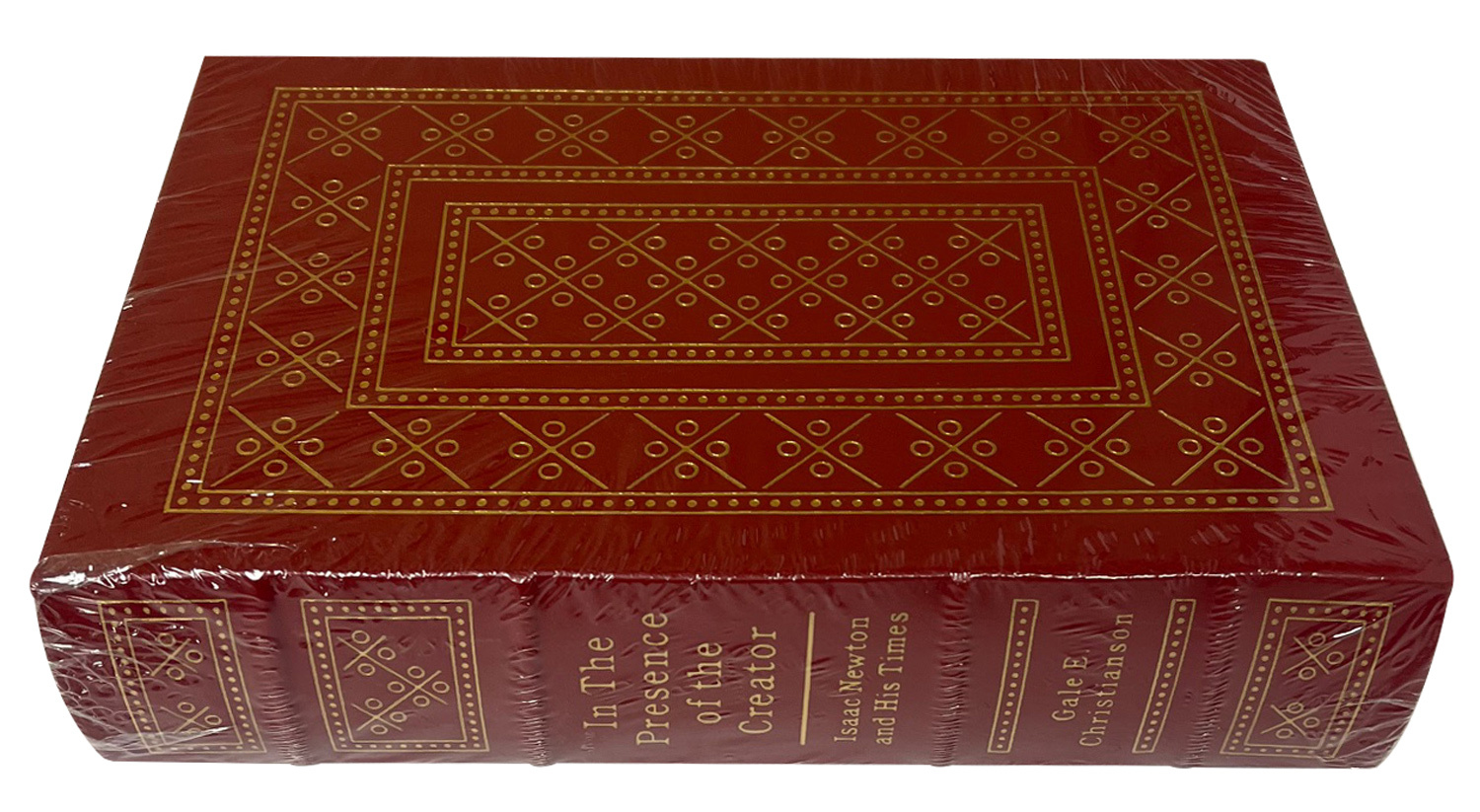
Easton Press, Norwalk CT. 1989 Gale E. Christianson "In the Presence of the Creator: Isaac Newton and His Times" Limited Edition. Luxuriously bound with full genuine leather. Sealed.
Gale E. Christianson has turned his full attention to one man alone, Isaac Newton, who emerges full-blown in these pages not merely as a preeminent astronomer but as the figure history has long known him to be : the greatest scientific thinker of modern times.
A biography of Newton probes the scientist's reclusive personality, recreates the turbulent intellectual atmosphere of seventeenth-century Europe, and lucidly describes Newton's epoch-making discoveries in physics, optics, and astronomy.
Gale Edward Christianson
Gale Edward Christianson, professor emeritus of history at Indiana State University, died Sunday, March 28, 2010, after suffering a heart attack. He grew up in Iowa and Nebraska, received a BA in political science from the University of Iowa in 1964, a MA in social science from the University of Northern Iowa in 1966, and a DA in history from the Carnegie Mellon University in 1971. He joined the faculty at Indiana State University in 1971, was promoted to professor in 1979, and was named a Distinguished Professor of the College of Arts and Sciences in 1987. He retired in 2003.
During his career Christianson was known as a demanding but popular teacher. He taught a variety of courses in his specialty, the history of science. For many years he also taught the foundation methods course for history and social studies education majors, a rigorous introduction to the field that was long remembered by those who took it, as well as a popular course on history through biography. He served on a variety of university and professional committees, including the university's Research Committee and General Education Council, and was a reviewer for numerous academic presses and grant agencies. He was also active in the Faculty Senate at Indiana State.
Sir Isaac Newton
Sir Isaac Newton (4 January 1643 – 31 March 1727) was an English polymath who was a mathematician, physicist, astronomer, alchemist, theologian, author and inventor. He was a key figure in the Scientific Revolution and the Enlightenment that followed. His book Philosophiæ Naturalis Principia Mathematica (Mathematical Principles of Natural Philosophy), first published in 1687, achieved the first great unification in physics and established classical mechanics. Newton also made seminal contributions to optics, and shares credit with the German mathematician Gottfried Wilhelm Leibniz for formulating infinitesimal calculus, although he developed calculus years before Leibniz. Newton contributed to and refined the scientific method, and his work is considered the most influential in bringing forth modern science.
In the Principia, Newton formulated the laws of motion and universal gravitation that formed the dominant scientific viewpoint for centuries until it was superseded by the theory of relativity. While this is the case, his laws still serve as excellent approximations for the vast majority of physical phenomena involving low speeds (much less than the speed of light) and weak gravitational fields. He used his mathematical description of gravity to derive Kepler's laws of planetary motion, account for tides, the trajectories of comets, the precession of the equinoxes and other phenomena, eradicating doubt about the Solar System's heliocentricity. Newton solved the two-body problem and introduced the three-body problem. He demonstrated that the motion of objects on Earth and celestial bodies could be accounted for by the same principles. Newton's inference that the Earth is an oblate spheroid was later confirmed by the geodetic measurements of Alexis Clairaut, Charles Marie de La Condamine, and others, convincing most European scientists of the superiority of Newtonian mechanics over earlier systems. He was also the first to calculate the age of Earth by experiment, and described a precursor to the modern wind tunnel. Further, he was the first to provide a quantitative estimate of the solar mass.
Newton built the first reflecting telescope and developed a sophisticated theory of color based on the observation that a prism separates white light into the colors of the visible spectrum. His work on light was collected in his book Opticks, published in 1704. He originated prisms as beam expanders and multiple-prism arrays, which would later become integral to the development of tunable lasers. He anticipated the wave–particle duality of light and was first to theorize the Goos–Hänchen effect. He also formulated an empirical law of cooling, which was the first heat transfer formulation and serves as the formal basis of convective heat transfer, made the first theoretical calculation of the speed of sound, and introduced the notions of a Newtonian fluid and a black body. He was also the first to explain the Magnus effect. Moreover, he was the first to analyze Couette flow. In addition to his creation of calculus, Newton's work on mathematics was extensive. He generalized the binomial theorem to any real number, introduced the Puiseux series, was the first to state Bézout's theorem, classified most of the cubic plane curves, contributed to the study of Cremona transformations, developed a method for approximating the roots of a function, originated the Newton–Cotes formulas used for numerical integration, and further produced the earliest explicit enunciation of the general Taylor series. Additionally, Newton initiated the field of calculus of variations, formulated and solved the earliest problem in geometric probability, devised the earliest form of linear regression, and was a pioneer of vector analysis.
Newton was a fellow of Trinity College and the second Lucasian Professor of Mathematics at the University of Cambridge; he was appointed at the age of 26. He was a devout but unorthodox Christian who privately rejected the doctrine of the Trinity. He refused to take holy orders in the Church of England, unlike most members of the Cambridge faculty of the day. Beyond his work on the mathematical sciences, Newton dedicated much of his time to the study of alchemy and biblical chronology, but most of his work in those areas remained unpublished until long after his death. Politically and personally tied to the Whigs, Newton served two brief terms as Member of Parliament for the University of Cambridge, in 1689–1690 and 1701–1702. He was knighted by Queen Anne in 1705 and spent the last three decades of his life in London, serving as Warden (1696–1699) and Master (1699–1727) of the Royal Mint, in which he increased the accuracy and security of British coinage. He was also the president of the Royal Society (1703–1727).
Features
Includes all the classic Easton Press qualities:* Premium Leather
* Silk Moire Endleaves
* Distinctive Cover Design
* Hubbed Spine, Accented in Real 22KT Gold
* Satin Ribbon Page Marker
* Gilded Page Edges
* Long-lasting, High Quality Acid-neutral Paper
* Smyth-sewn Pages for Strength and Durability
- Publisher:
- Easton Press
- Edition:
- Limited Edition
- Binding:
- Full genuine leather
- Author:
- Gale E. Christianson
- Title:
- In the Presence of the Creator: Isaac Newton and His Times
![Philipp Frank "Einstein: His Life And Times" Limited Edition, Leather Bound Collector's Edition [Sealed]](https://cdn11.bigcommerce.com/s-eohzfjch7f/images/stencil/500x659/products/1357/5517/ep2065-2__95840.1601671317.jpg?c=1 "Philipp Frank \"Einstein: His Life And Times\" Limited Edition, Leather Bound Collector's Edition [Sealed]")
![Gerald Ford "A Time To Heal" Signed Limited Edition, Leather Bound Collector's Edition [Sealed]](https://cdn11.bigcommerce.com/s-eohzfjch7f/images/stencil/500x659/products/3064/28516/1000x1250__25327.1761988039.jpg?c=1 "Gerald Ford \"A Time To Heal\" Signed Limited Edition, Leather Bound Collector's Edition [Sealed]")
![Vladimir Nabokov "Lolita" Limited Edition, Leather Bound Collector's Edition [Sealed]](https://cdn11.bigcommerce.com/s-eohzfjch7f/images/stencil/500x659/products/3094/16370/IMG_3916_edited__27664.1681925137.jpg?c=1 "Vladimir Nabokov \"Lolita\" Limited Edition, Leather Bound Collector's Edition [Sealed]")
![Thomas Marent "Butterfly" Limited Edition, Leather Bound Collector's Edition [Sealed]](https://cdn11.bigcommerce.com/s-eohzfjch7f/images/stencil/500x659/products/2917/12135/IMG_1473_edited__23491.1651315102.jpg?c=1 "Thomas Marent \"Butterfly\" Limited Edition, Leather Bound Collector's Edition [Sealed]")
![James Joyce "Ulysses" Limited Edition, Leather Bound Collector's Edition [Sealed]](https://cdn11.bigcommerce.com/s-eohzfjch7f/images/stencil/500x659/products/2195/8178/James_Joyce_Ulysses_7_4__56058.1606329989.jpg?c=1 "James Joyce \"Ulysses\" Limited Edition, Leather Bound Collector's Edition [Sealed]")