![Richard P. Feynman "Six Easy Pieces" Limited Edition, Leather Bound Collector's Edition [Sealed]](https://cdn11.bigcommerce.com/s-eohzfjch7f/images/stencil/500x659/products/1663/30267/1000x1250__52419.1773248449.jpg?c=1 "Richard P. Feynman \"Six Easy Pieces\" Limited Edition, Leather Bound Collector's Edition [Sealed]")
![Richard P. Feynman "Six Easy Pieces" Limited Edition, Leather Bound Collector's Edition [Sealed]](https://cdn11.bigcommerce.com/s-eohzfjch7f/images/stencil/1280x1280/products/1663/30267/1000x1250__52419.1773248449.jpg?c=1 "Richard P. Feynman \"Six Easy Pieces\" Limited Edition, Leather Bound Collector's Edition [Sealed]")
![Richard P. Feynman "Six Easy Pieces" Limited Edition, Leather Bound Collector's Edition [Sealed]](https://cdn11.bigcommerce.com/s-eohzfjch7f/images/stencil/50x50/products/1663/30267/1000x1250__52419.1773248449.jpg?c=1 "Richard P. Feynman \"Six Easy Pieces\" Limited Edition, Leather Bound Collector's Edition [Sealed]")
![Richard P. Feynman "Six Easy Pieces" Limited Edition, Leather Bound Collector's Edition [Sealed]](https://cdn11.bigcommerce.com/s-eohzfjch7f/images/stencil/50x50/products/1663/30272/IMG_1425_edited__99433.1773248449.jpg?c=1 "Richard P. Feynman \"Six Easy Pieces\" Limited Edition, Leather Bound Collector's Edition [Sealed]")
![Richard P. Feynman "Six Easy Pieces" Limited Edition, Leather Bound Collector's Edition [Sealed]](https://cdn11.bigcommerce.com/s-eohzfjch7f/images/stencil/50x50/products/1663/30271/IMG_1426_edited__79262.1773248449.jpg?c=1 "Richard P. Feynman \"Six Easy Pieces\" Limited Edition, Leather Bound Collector's Edition [Sealed]")
![Richard P. Feynman "Six Easy Pieces" Limited Edition, Leather Bound Collector's Edition [Sealed]](https://cdn11.bigcommerce.com/s-eohzfjch7f/images/stencil/50x50/products/1663/30270/IMG_1427_edited__97457.1773248449.jpg?c=1 "Richard P. Feynman \"Six Easy Pieces\" Limited Edition, Leather Bound Collector's Edition [Sealed]")
![Richard P. Feynman "Six Easy Pieces" Limited Edition, Leather Bound Collector's Edition [Sealed]](https://cdn11.bigcommerce.com/s-eohzfjch7f/images/stencil/50x50/products/1663/30269/IMG_1428_edited__03068.1773248449.jpg?c=1 "Richard P. Feynman \"Six Easy Pieces\" Limited Edition, Leather Bound Collector's Edition [Sealed]")
![Richard P. Feynman "Six Easy Pieces" Limited Edition, Leather Bound Collector's Edition [Sealed]](https://cdn11.bigcommerce.com/s-eohzfjch7f/images/stencil/50x50/products/1663/30266/IMG_1429_edited__57053.1773248449.jpg?c=1 "Richard P. Feynman \"Six Easy Pieces\" Limited Edition, Leather Bound Collector's Edition [Sealed]")
![Richard P. Feynman "Six Easy Pieces" Limited Edition, Leather Bound Collector's Edition [Sealed]](https://cdn11.bigcommerce.com/s-eohzfjch7f/images/stencil/50x50/products/1663/30268/IMG_1430_edited__14815.1773248449.jpg?c=1 "Richard P. Feynman \"Six Easy Pieces\" Limited Edition, Leather Bound Collector's Edition [Sealed]")
![Richard P. Feynman "Six Easy Pieces" Limited Edition, Leather Bound Collector's Edition [Sealed]](https://cdn11.bigcommerce.com/s-eohzfjch7f/images/stencil/1280x1280/products/1663/30267/1000x1250__52419.1773248449.jpg "Richard P. Feynman \"Six Easy Pieces\" Limited Edition, Leather Bound Collector's Edition [Sealed]")
![Richard P. Feynman "Six Easy Pieces" Limited Edition, Leather Bound Collector's Edition [Sealed]](https://cdn11.bigcommerce.com/s-eohzfjch7f/images/stencil/1280x1280/products/1663/30272/IMG_1425_edited__99433.1773248449.jpg "Richard P. Feynman \"Six Easy Pieces\" Limited Edition, Leather Bound Collector's Edition [Sealed]")
![Richard P. Feynman "Six Easy Pieces" Limited Edition, Leather Bound Collector's Edition [Sealed]](https://cdn11.bigcommerce.com/s-eohzfjch7f/images/stencil/1280x1280/products/1663/30271/IMG_1426_edited__79262.1773248449.jpg "Richard P. Feynman \"Six Easy Pieces\" Limited Edition, Leather Bound Collector's Edition [Sealed]")
![Richard P. Feynman "Six Easy Pieces" Limited Edition, Leather Bound Collector's Edition [Sealed]](https://cdn11.bigcommerce.com/s-eohzfjch7f/images/stencil/1280x1280/products/1663/30270/IMG_1427_edited__97457.1773248449.jpg "Richard P. Feynman \"Six Easy Pieces\" Limited Edition, Leather Bound Collector's Edition [Sealed]")
![Richard P. Feynman "Six Easy Pieces" Limited Edition, Leather Bound Collector's Edition [Sealed]](https://cdn11.bigcommerce.com/s-eohzfjch7f/images/stencil/1280x1280/products/1663/30269/IMG_1428_edited__03068.1773248449.jpg "Richard P. Feynman \"Six Easy Pieces\" Limited Edition, Leather Bound Collector's Edition [Sealed]")
![Richard P. Feynman "Six Easy Pieces" Limited Edition, Leather Bound Collector's Edition [Sealed]](https://cdn11.bigcommerce.com/s-eohzfjch7f/images/stencil/1280x1280/products/1663/30266/IMG_1429_edited__57053.1773248449.jpg "Richard P. Feynman \"Six Easy Pieces\" Limited Edition, Leather Bound Collector's Edition [Sealed]")
![Richard P. Feynman "Six Easy Pieces" Limited Edition, Leather Bound Collector's Edition [Sealed]](https://cdn11.bigcommerce.com/s-eohzfjch7f/images/stencil/1280x1280/products/1663/30268/IMG_1430_edited__14815.1773248449.jpg "Richard P. Feynman \"Six Easy Pieces\" Limited Edition, Leather Bound Collector's Edition [Sealed]")
An Extraordinary Leather-Bound Limited Edition by the Nobel Prize-winning physicist Richard Feynman, featuring the six most accessible chapters from his famous Lectures on Physics.
Easton Press, Norwalk CT. 1991 Richard Feynman "Six Easy Pieces" Limited Edition. Luxuriously bound with full genuine leather with 22kt gold accents. Sealed.
Six Easy Pieces is a book by Nobel Prize-winning physicist Richard Feynman, featuring the six most accessible chapters from his famous Lectures on Physics, aimed at a general audience with minimal equations. It covers fundamental topics like atoms, basic physics, energy, gravitation, and quantum mechanics, showcasing Feynman's unique, witty, and clear teaching style through simple examples and illustrations. The book is celebrated for making complex physics understandable and is considered a classic introduction to the subject.
It was Richard Feynman's outrageous and scintillating method of teaching that earned him legendary status among students and professors of physics. From 1961 to 1963, Feynman delivered a series of lectures at the California Institute of Technology that revolutionized the teaching of physics around the world. Six Easy Pieces, taken from these famous Lectures on Physics, represent the most accessible material from the series.
In these classic lessons, Feynman introduces the general reader to the following topics: atoms, basic physics, energy, gravitation, quantum mechanics, and the relationship of physics to other topics. With his dazzling and inimitable wit, Feynman presents each discussion with a minimum of jargon. Filled with wonderful examples and clever illustrations, Six Easy Pieces is the ideal introduction to the fundamentals of physics by one of the most admired and accessible physicists of modern times.
Key aspects of the book:
Origin: Compiled from lectures Feynman gave at Caltech from 1961–1963.
Content: Introduces core physics concepts:
- Atoms in motion
- Basic physics
- The relationship of physics to other sciences
- The conservation of energy
- Gravitation
- Quantum behavior
Style: Uses wit, simple examples (like using ice and rubber), and minimal jargon to explain complex ideas.
Audience: Designed for the general reader, students, and anyone with an interest in physics.
Legacy: Considered a masterpiece of science communication, allowing readers to experience Feynman's legendary teaching.
Reviews
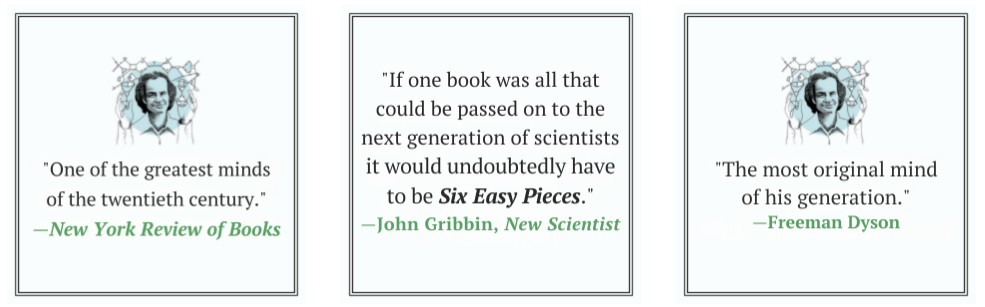
"One of the greatest minds of the twentieth century"―New York Review of Books
"The essence of physics and Feynman. No jargon, just ideas, excitement, and the straight dope. And real answers, like 'we don't know.'"―Stephen Wolfram
"The most original mind of his generation."―Freeman Dyson
"If one book was all that could be passed on to the next generation of scientists it would undoubtedly have to be Six Easy Pieces."―John Gribbin, New Scientist
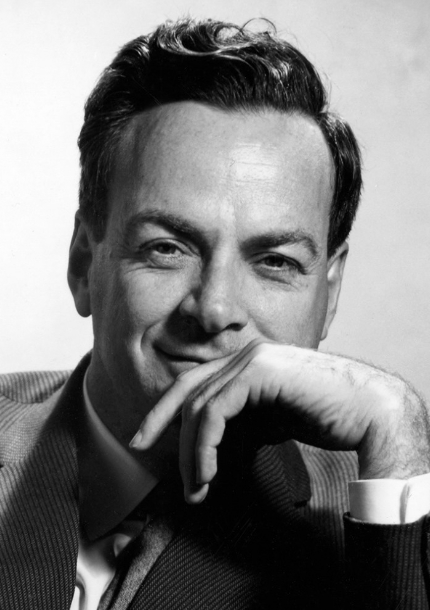
Richard Feynman
Richard Phillips Feynman (/ˈfaɪnmən/; May 11, 1918 – February 15, 1988) was an American theoretical physicist. He shared the 1965 Nobel Prize in Physics with Julian Schwinger and Shin'ichirō Tomonaga "for their fundamental work in quantum electrodynamics (QED), with deep-ploughing consequences for the physics of elementary particles". He is also known for his work in the path integral formulation of quantum mechanics, the theory of the physics of the superfluidity of supercooled liquid helium, and the parton model. Feynman developed a pictorial representation scheme for the mathematical expressions describing the behavior of subatomic particles, which later became known as Feynman diagrams and is widely used.
He assisted in the development of the atomic bomb during World War II and became known to the wider public in the 1980s as a member of the Rogers Commission, the panel that investigated the Space Shuttle Challenger disaster. Along with his work in theoretical physics, Feynman has been credited with having pioneered the field of quantum computing and introducing the concept of nanotechnology. He held the Richard C. Tolman professorship in theoretical physics at the California Institute of Technology. In a 1999 poll of 130 leading physicists worldwide by the British journal Physics World, he was ranked the seventh-greatest physicist of all time.
Feynman was a keen physics popularizer through books and lectures, including a talk on top-down nanotechnology, "There's Plenty of Room at the Bottom" (1959) and his undergraduate lectures, The Feynman Lectures on Physics (1961–1964). He delivered lectures for lay audiences, recorded in The Character of Physical Law (1965) and QED: The Strange Theory of Light and Matter (1985). Feynman also became known through Ralph Leighton's collections of his anecdotes, Surely You're Joking, Mr. Feynman! (1985) and What Do You Care What Other People Think? (1988). Leighton covered his dream of travelling to Tannu Tuva in Tuva or Bust!. He has been the subject of several biographies, starting with Genius: The Life and Science of Richard Feynman by James Gleick.
Features
Includes all the classic Easton Press qualities:* Premium Leather
* Silk Moire Endleaves
* Distinctive Cover Design
* Hubbed Spine, Accented in Real 22KT Gold
* Satin Ribbon Page Marker
* Gilded Page Edges
* Long-lasting, High Quality Acid-neutral Paper
* Smyth-sewn Pages for Strength and Durability
* Beautiful Illustrations
- Publisher:
- Easton Press
- Edition:
- Limited Edition
- Binding:
- Leather Bound
- Author:
- Richard P. Feynman
- Title:
- Six Easy Pieces

![Richard Matheson "I Am Legend" Limited Edition, Leather-Bound Collector's Edition [Sealed]](https://cdn11.bigcommerce.com/s-eohzfjch7f/images/stencil/500x659/products/3457/29081/1000x1250__86735.1767302223.jpg?c=1 "Richard Matheson \"I Am Legend\" Limited Edition, Leather-Bound Collector's Edition [Sealed]")
![Vladimir Nabokov "Lolita" Limited Edition, Leather Bound Collector's Edition [Sealed]](https://cdn11.bigcommerce.com/s-eohzfjch7f/images/stencil/500x659/products/3094/16370/IMG_3916_edited__27664.1681925137.jpg?c=1 "Vladimir Nabokov \"Lolita\" Limited Edition, Leather Bound Collector's Edition [Sealed]")
![Thomas Marent "Butterfly" Limited Edition, Leather Bound Collector's Edition [Sealed]](https://cdn11.bigcommerce.com/s-eohzfjch7f/images/stencil/500x659/products/2917/12135/IMG_1473_edited__23491.1651315102.jpg?c=1 "Thomas Marent \"Butterfly\" Limited Edition, Leather Bound Collector's Edition [Sealed]")
![James Joyce "Ulysses" Limited Edition, Leather Bound Collector's Edition [Sealed]](https://cdn11.bigcommerce.com/s-eohzfjch7f/images/stencil/500x659/products/2195/8178/James_Joyce_Ulysses_7_4__56058.1606329989.jpg?c=1 "James Joyce \"Ulysses\" Limited Edition, Leather Bound Collector's Edition [Sealed]")