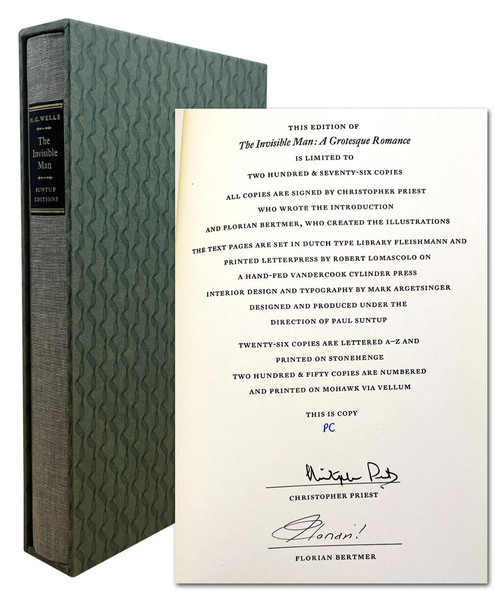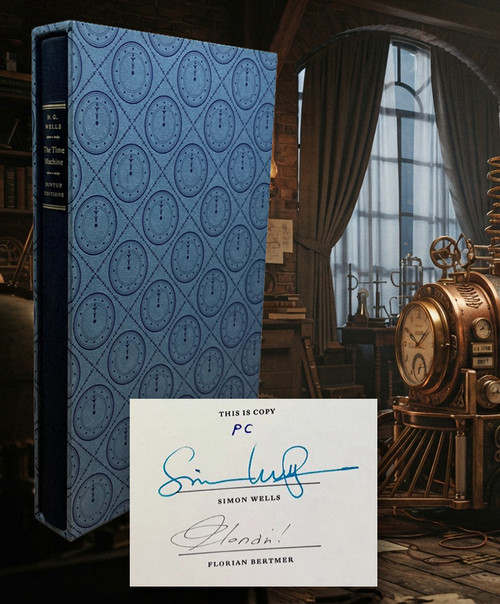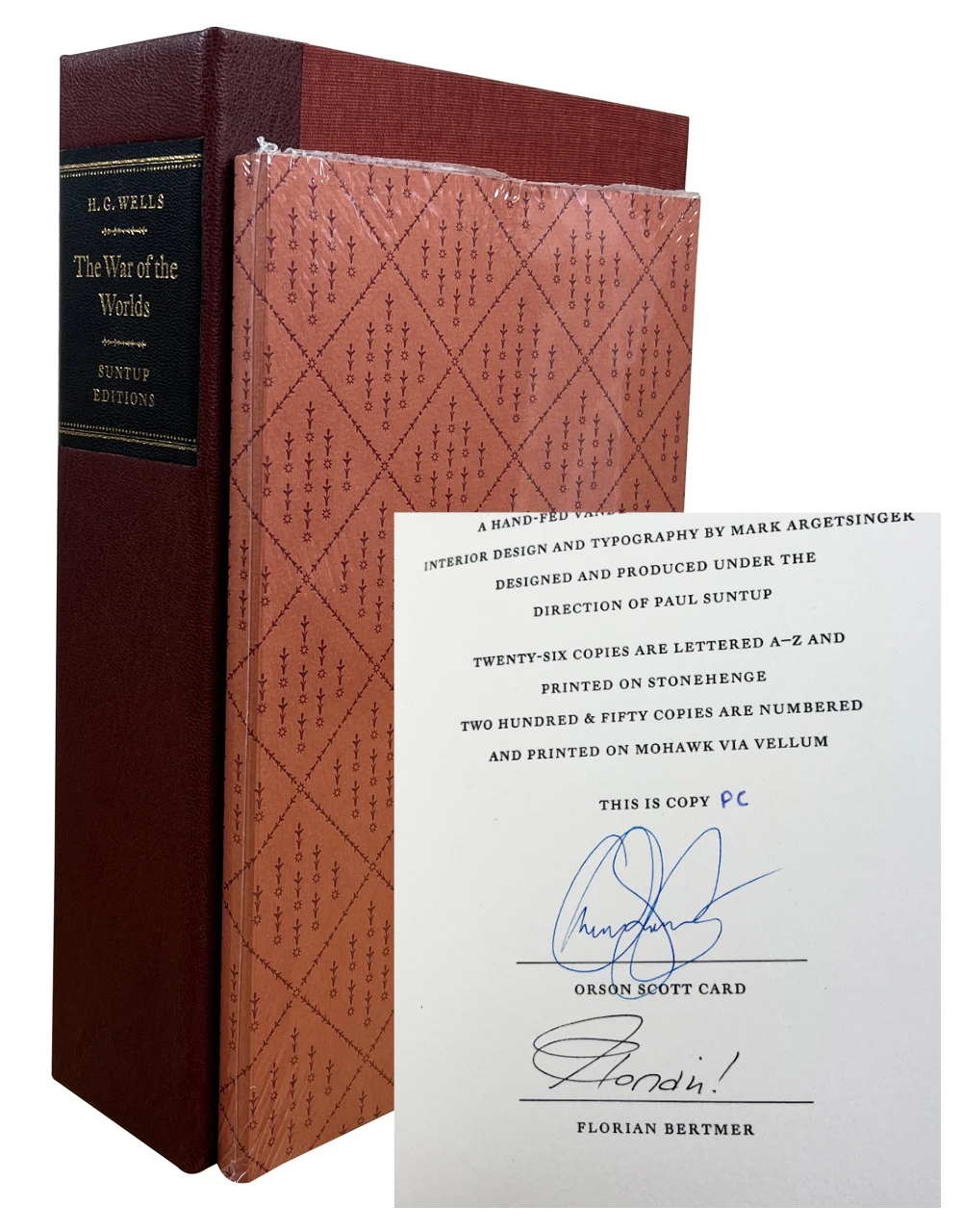


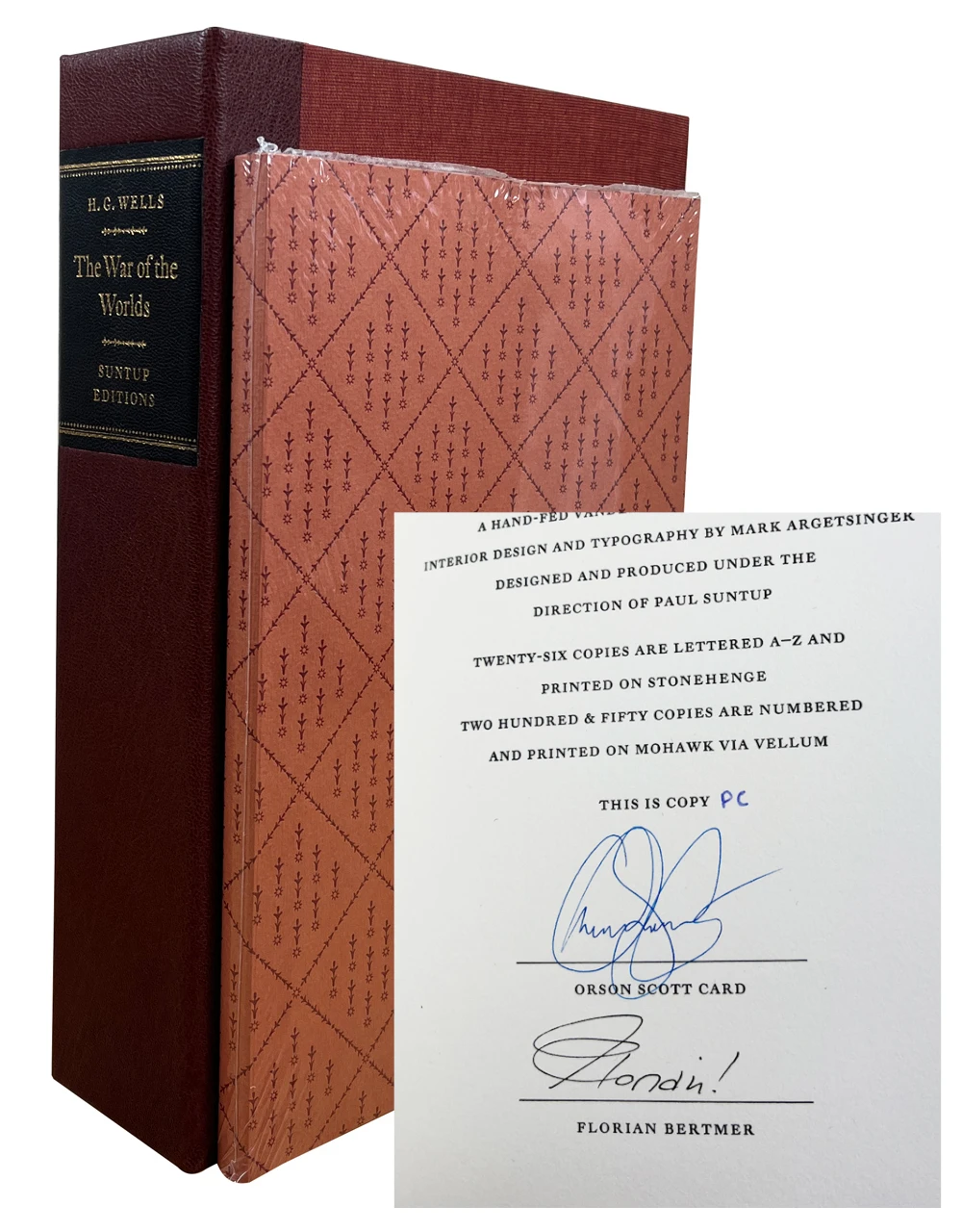


 Certified Authentic
Personally signed by Orson Scott Card and Florian Bertmer.
SIGNED LETTERED EDITION OF ONLY 26. THIS IS THE "PC" EDITION.
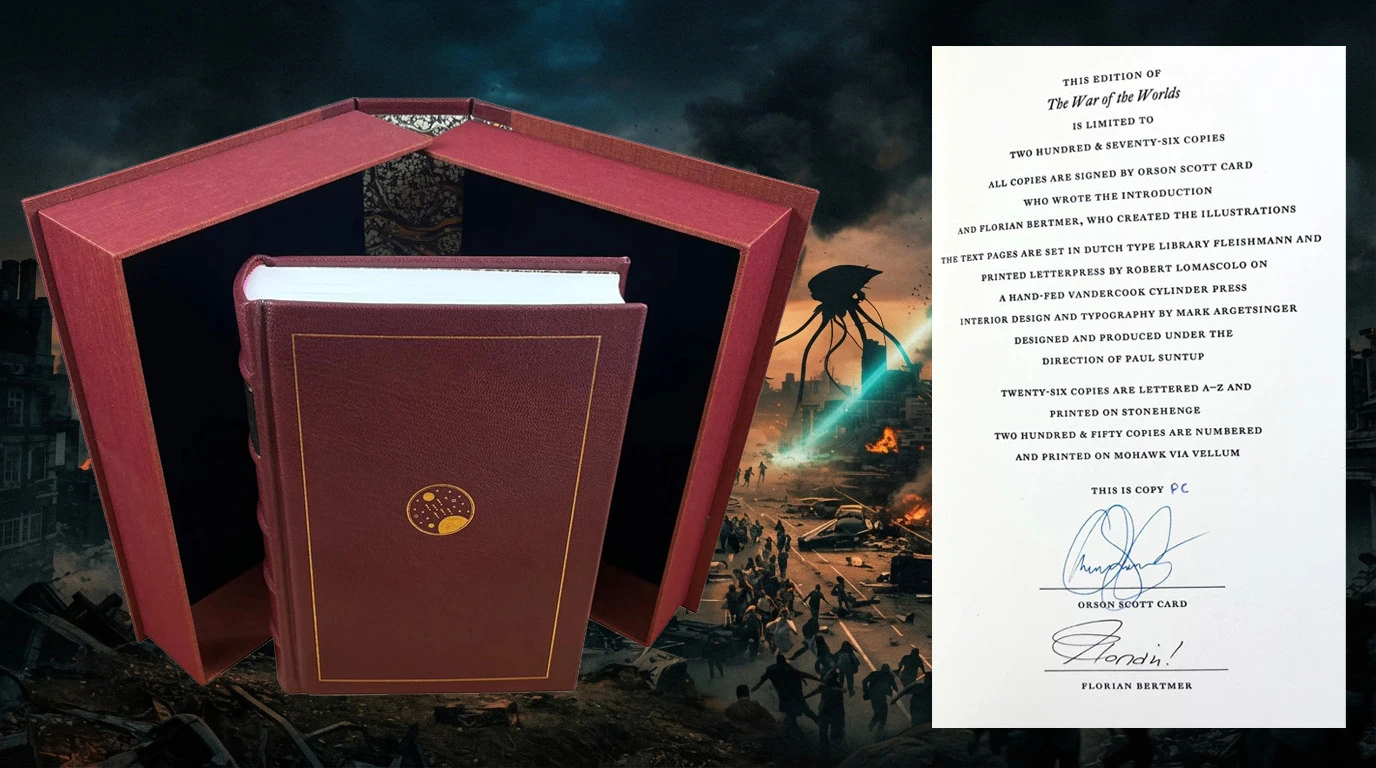
Suntup Editions (March 2020) H.G. Wells "The War of the Worlds". Signed by Orson Scott Card and Florian Bertmer on the special title page. Lettered Edition of only 26 produced. "PC" edition. Housed in a quarter leather clam-shell enclosure with a rounded spine and cloth boards. Leather-bound. Gold foil stamping on the cover. Raised bands on the spine with a leather spine label. Very Fine.
Signed Lettered Edition
- Signed by Orson Scott Card and Florian Bertmer.
- 6” x 9” trim size.
- Rounded smyth-sewn binding.
- Full goatskin handbinding with gold foil stamping on the cover.
- Raised bands on the spine with a leather spine label.
- Introduction by Orson Scott Card.
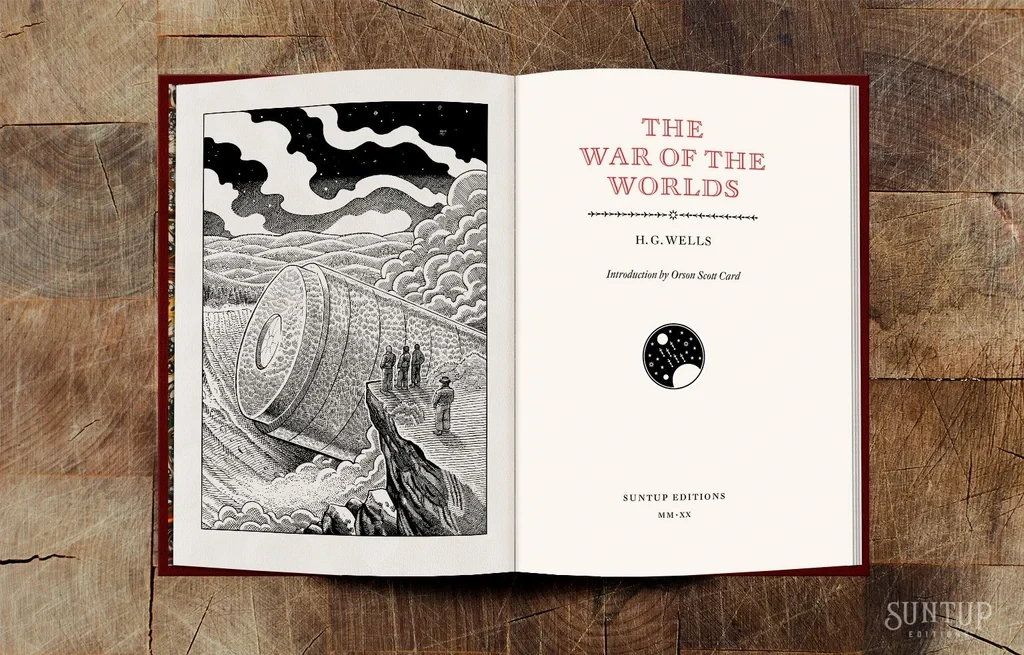
- Six ink illustrations by Florian Bertmer printed letterpress along with the text.
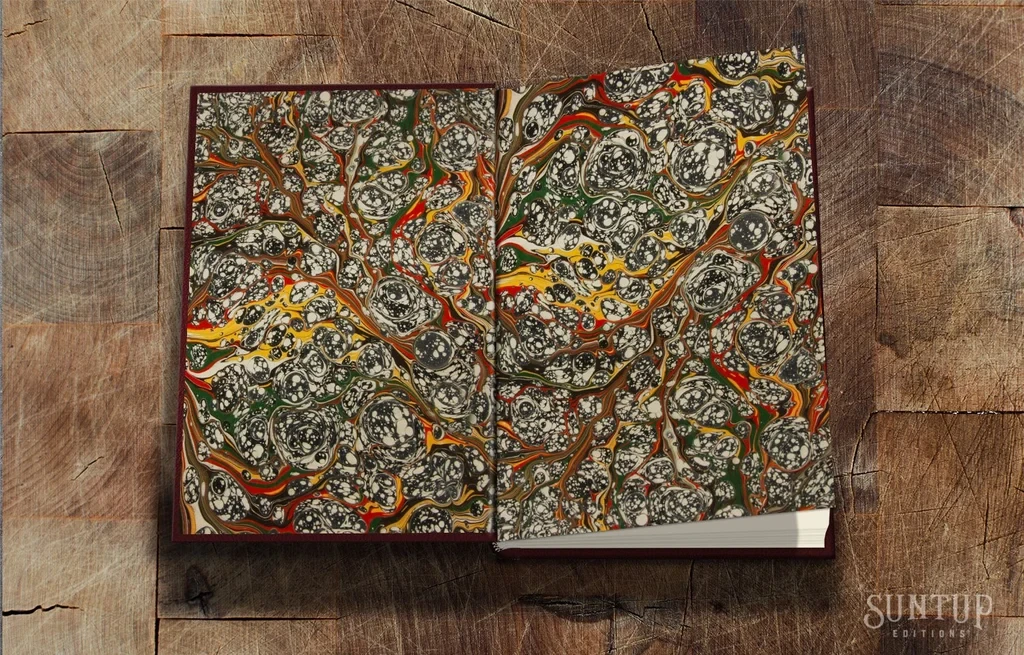
- Endpapers hand marbled in the U.K.
- Printed letterpress on Stonehenge cotton paper.
- Two color printing on title page.
- Housed in a quarter leather clamshell enclosure with a rounded spine and cloth boards.
- Limited to 26 copies.
Includes 112 Page Bonus Material Booklet
- The Crystal Egg – Precursor to The War of the Worlds
- The Things That Live on Mars by H.G. Wells – Cosmopolitan Article
- Orson Welles 1938 Radio Broadcast Script
- Reprint of The Boston Daily Globe’s front page headline
- Reproductions of 32 famous Henrique Alvim Corrêa drawings
- Art from Jeff Wayne’s Musical Version of The War of the Worlds
The War of the Worlds
The War of the Worlds is a science fiction novel by English author H. G. Wells, first serialised in 1897 by Pearson's Magazine in the UK and by Cosmopolitan magazine in the US. The novel's first appearance in hardcover was in 1898 from publisher William Heinemann of London. Written between 1895 and 1897, it is one of the earliest stories to detail a conflict between mankind and an extra-terrestrial race. The novel is the first-person narrative of both an unnamed protagonist in Surrey and of his younger brother in London as southern England is invaded by Martians. The novel is one of the most commented-on works in the science fiction canon.
The plot has been related to invasion literature of the time. The novel has been variously interpreted as a commentary on evolutionary theory, British imperialism, and generally Victorian superstitions, fears, and prejudices. Wells said that the plot arose from a discussion with his brother Frank about the catastrophic effect of the British on indigenous Tasmanians. What would happen, he wondered, if Martians did to Britain what the British had done to the Tasmanians? At the time of publication, it was classified as a scientific romance, like Wells's earlier novel The Time Machine.
The War of the Worlds has been both popular (having never been out of print) and influential, spawning half a dozen feature films, radio dramas, a record album, various comic book adaptations, a number of television series, and sequels or parallel stories by other authors. It was most memorably dramatised in a 1938 radio programme directed by and starring Orson Welles that allegedly caused public panic among listeners who did not know the Martian invasion was fictional. The novel has even influenced the work of scientists, notably Robert H. Goddard, who, inspired by the book, helped develop both the liquid-fuelled rocket and multistage rocket, which resulted in the Apollo 11 Moon landing 71 years later.
H.G. Wells
Herbert George Wells (21 September 1866 – 13 August 1946) was an English writer. Prolific in many genres, he wrote dozens of novels, short stories, and works of social commentary, history, satire, biography and autobiography. His work also included two books on recreational war games. Wells is now best remembered for his science fiction novels and is often called the "father of science fiction", along with Jules Verne and the publisher Hugo Gernsback.
During his own lifetime, however, he was most prominent as a forward-looking, even prophetic social critic who devoted his literary talents to the development of a progressive vision on a global scale. A futurist, he wrote a number of utopian works and foresaw the advent of aircraft, tanks, space travel, nuclear weapons, satellite television and something resembling the World Wide Web. His science fiction imagined time travel, alien invasion, invisibility, and biological engineering. Brian Aldiss referred to Wells as the "Shakespeare of science fiction".
Wells rendered his works convincing by instilling commonplace detail alongside a single extraordinary assumption – dubbed “Wells's law” – leading Joseph Conrad to hail him in 1898 as "O Realist of the Fantastic!". His most notable science fiction works include The Time Machine (1895), The Island of Doctor Moreau (1896), The Invisible Man (1897), The War of the Worlds (1898) and the military science fiction The War in the Air (1907). Wells was nominated for the Nobel Prize in Literature four times.
Wells's earliest specialised training was in biology, and his thinking on ethical matters took place in a specifically and fundamentally Darwinian context.[9] He was also from an early date an outspoken socialist, often (but not always, as at the beginning of the First World War) sympathising with pacifist views. His later works became increasingly political and didactic, and he wrote little science fiction, while he sometimes indicated on official documents that his profession was that of journalist. Novels such as Kipps and The History of Mr Polly, which describe lower-middle-class life, led to the suggestion that he was a worthy successor to Charles Dickens, but Wells described a range of social strata and even attempted, in Tono-Bungay (1909), a diagnosis of English society as a whole. Wells was a diabetic and co-founded the charity The Diabetic Association (known today as Diabetes UK) in 1934.

Orson Scott Card
Orson Scott Card (born August 24, 1951) is an American writer known best for his science fiction works. As of 2024, he is the only person to have won a Hugo Award and a Nebula Award in consecutive years, winning both awards for his novel Ender's Game (1985) and its sequel Speaker for the Dead (1986). A feature film adaptation of Ender's Game, which Card coproduced, was released in 2013. Card also wrote the Locus Fantasy Award-winning series The Tales of Alvin Maker (1987–2026). Card's fiction often features characters with exceptional gifts who make difficult choices with high stakes. Card has also written political, religious, and social commentary in his columns and other writing; he has provoked controversy and criticism for his public opposition to homosexuality.
Card, who is a great-great-grandson of Brigham Young, was born in Richland, Washington, and grew up in Utah and California. While he was a student at Brigham Young University (BYU), his plays were performed on stage. He served in Brazil as a missionary for the Church of Jesus Christ of Latter-day Saints (LDS Church) and headed a community theater for two summers. Card had 27 short stories published between 1978 and 1979, and he won the John W. Campbell Award for Best New Writer in 1978. He earned a master's degree in English from the University of Utah in 1981 and wrote novels in science fiction, fantasy, nonfiction, and historical fiction genres starting in 1979. Card continued to write prolifically, and he has published over 50 novels and 45 short stories.
Card teaches English at Southern Virginia University; he has written two books on creative writing and serves as a judge in the Writers of the Future contest. He has taught many successful writers at his "literary boot camps".
Florian Bertmer
Florian Bertmer is quite an enigma.
Little is known about the german-born artist but we do know that he recently moved to Los Angeles, CA.
He has a flair for the macabre and a profound knowledge of the occult and most likely knows more about it than Crowley himself.
His unique and insanely detailed style draws inspiration from traditional pen and ink illustrators such as Alphonse Mucha, Geoff Darrow, Pushead, Mike Mignola and Ed Roth.
He started his career creating record covers and music merchandise for a wide variety of legendary bands such as Napalm Death, Converge, Dillinger Escape Plan, The Misfits, Mastodon and Agoraphobic Nosebleed, just to name a few.
He recently made his way into the realm of movie posters, creating movie poster art for such iconic films such as Holy Mountain, Texas Chainsaw Massacre, Swamp Thing and Planet of the Apes.
source: https://www.florianbertmer.com/about
Florian Bertmer is a German illustrator from the hardcore punk, grindcore and metal scene. He has done artwork for bands and companies like Converge, Napalm Death, Danzig, Black Sabbath, Puscifer, The Hope Conspiracy, The Dillinger Escape Plan, Agoraphobic Nosebleed, Pig Destroyer, Doomriders, Kirk Hammett, Lucasfilm, Alamo Drafthouse, Netflix, Funko and others. His early works were reminiscent of Pushead while his later works have become more influenced by Art Nouveau and Occultism . He fronted the band Cheerleaders Of The Apocalypse. He has also created several official movie posters in collaboration with Alamo Drafthouse Cinema and has designed deck art for skateboard companies such as Creature Skateboards or Substance Abuse.

- Publisher:
- Suntup Editions
- Edition:
- Signed Lettered Edition
- Author:
- H.G. Wells
- Title:
- War Of The Worlds
- Certification:
- Publisher
- Publication Date:
- 2020